
Olivia Peters · 28 September 2026
Navigating Backend Data Pathways for Sustained Performance in Evolving SaaS Ecosystems
Backend data pathways form the core infrastructure that moves information between services, databases, and user interfaces in SaaS platforms, and organizations track these routes through logging systems that capture latency, throughput, and error rates at each junction. Research from the National Institute of Standards and Technology highlights how structured data routing reduces bottlenecks when platforms scale across distributed cloud environments.
Teams monitor query patterns and connection pools because these elements determine whether requests reach their destinations without delays during peak usage periods. Data indicates that platforms handling millions of transactions per day rely on dynamic path selection algorithms to reroute traffic around congested nodes, and this approach maintains response times under varying loads.
Core Components of Data Pathway Management
Database sharding and replication strategies split workloads across multiple instances, which allows systems to handle concurrent access without overwhelming single points of storage. Observers note that connection multiplexing techniques further consolidate multiple client requests into fewer backend channels, and this consolidation cuts overhead while preserving data integrity across sessions.
Caching layers sit between application servers and primary databases, storing frequently accessed records to shorten retrieval paths. Studies show these layers can decrease average query times by factors of ten or more when configured with appropriate expiration policies that balance freshness against speed.
Adaptations Required in Growing SaaS Environments
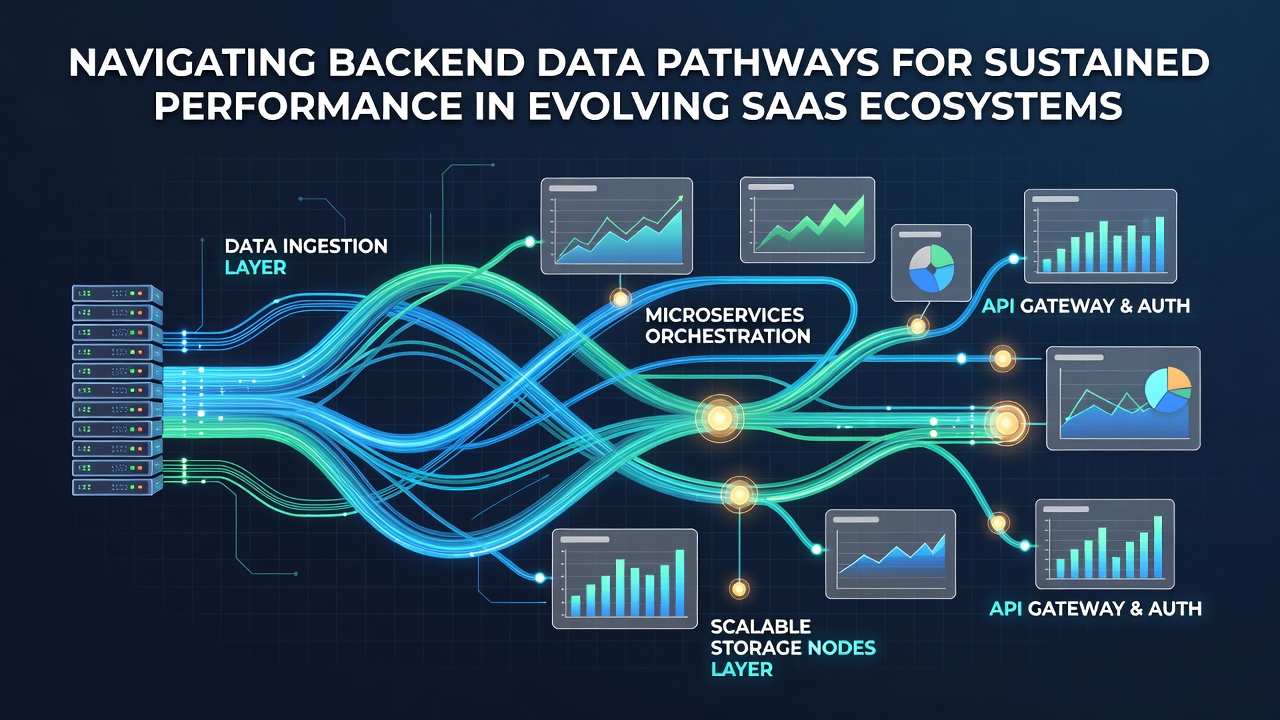
As SaaS ecosystems add new microservices and expand geographic regions, data pathways must accommodate increased inter-service communication without introducing latency spikes. Engineers implement message queues and event-driven architectures to decouple components, which lets each service process information at its own pace while still feeding results forward along defined routes.
Projections tied to September 2026 indicate continued growth in multi-tenant architectures, where isolation between customer datasets demands precise access controls along every pathway. NIST cloud computing guidelines outline standards for these controls, emphasizing encryption at rest and in transit as baseline requirements.
Load balancers and service meshes direct traffic intelligently by evaluating real-time metrics such as CPU utilization and network congestion. When one region experiences higher demand, these systems shift requests to underutilized nodes, and this redistribution prevents localized slowdowns from affecting the entire platform.
Monitoring and Optimization Techniques
Continuous observability tools collect telemetry from every segment of the data pathway, generating alerts when thresholds for latency or error rates are crossed. Analysts review these datasets to identify recurring patterns, then adjust indexing strategies or introduce additional read replicas to relieve pressure on primary stores.
Automated testing frameworks simulate traffic surges to validate that pathway configurations hold under stress. Results from such tests help teams refine retry logic and circuit breakers that prevent cascading failures when individual services become unresponsive.
Integration of External Data Sources and Compliance
Many SaaS platforms pull information from third-party APIs and data feeds, which requires secure, authenticated connections that do not expose internal pathways to external risks. Research conducted at the University of Toronto demonstrates effective use of zero-trust models for these integrations, where every request undergoes verification regardless of origin.
Compliance frameworks in the European Union and Australia mandate audit trails that document data movement across borders. Organizations maintain logs that satisfy these requirements while still allowing rapid access for performance troubleshooting.
Conclusion
Effective navigation of backend data pathways depends on coordinated use of sharding, caching, monitoring, and adaptive routing to support sustained performance as SaaS ecosystems evolve. Data from industry reports and academic studies continues to guide refinements in these areas, ensuring platforms can meet growing demands without compromising reliability or compliance.